TL;DR
ESG reporting is becoming more structured, more regulated, and more demanding. With frameworks like CSRD and IFRS S1/S2, companies need reliable, comparable data, especially on Scope 3 and carbon emissions. The organizations that prepare early by improving their systems and processes won’t just meet compliance requirements, they’ll gain clearer insights to guide better business decisions.
Current State of ESG Reporting
What used to be largely voluntary disclosures has become a serious business requirement. Companies are now expected to report not only on financial results, but also on environmental impact, social responsibility, and governance practices.
But in many organizations, ESG reporting still looks like this:
Data scattered across departments
Manual collection processes
Heavy reliance on spreadsheets
Last-minute consolidation before deadlines
This reactive approach creates stress, increases the risk of errors, and makes it difficult to use ESG data for actual decision-making. As expectations rise, this model simply doesn’t hold up.
Emerging Regulatory Requirements (IFRS S1/S2, CSRD, SEC)
Regulation is one of the biggest forces shaping the future of ESG reporting.
In Europe, the Corporate Sustainability Reporting Directive (CSRD) significantly expands the number of companies required to disclose ESG information. It introduces standardized metrics and emphasizes double materiality how sustainability issues impact the company and how the company impacts society and the environment.
Globally, IFRS S1 and IFRS S2 aim to create a consistent baseline for sustainability and climate disclosures, linking ESG data more closely with financial reporting.
In the United States, the SEC’s proposed climate disclosure rules push companies toward more structured and auditable emissions reporting.
The overall direction is clear: ESG reporting is becoming more standardized, more comparable, and more closely scrutinized, much like financial reporting.
Technology is Reshaping ESG Management
As complexity increases, so does the need for better tools.
More companies are moving away from disconnected spreadsheets and toward dedicated ESG platforms that centralize data across teams and business units.
Automation and AI are increasingly part of this shift. When used well, they can:
Detect missing or inconsistent data
Support carbon calculations
Align internal policies with regulatory frameworks
Assist with questionnaire-based assessments like EcoVadis
Connect ESG metrics directly to reporting requirements
Perhaps the most important shift is this: ESG is moving from an annual reporting exercise to continuous performance tracking. Instead of collecting data once a year, companies can monitor progress in real time.
Key Trends Shaping ESG Reporting
Several major trends are expected to define ESG reporting in 2026 and beyond.
Real-time ESG data is becoming the new expectation. Companies are moving away from annual snapshots and towards continuous tracking of key indicators.
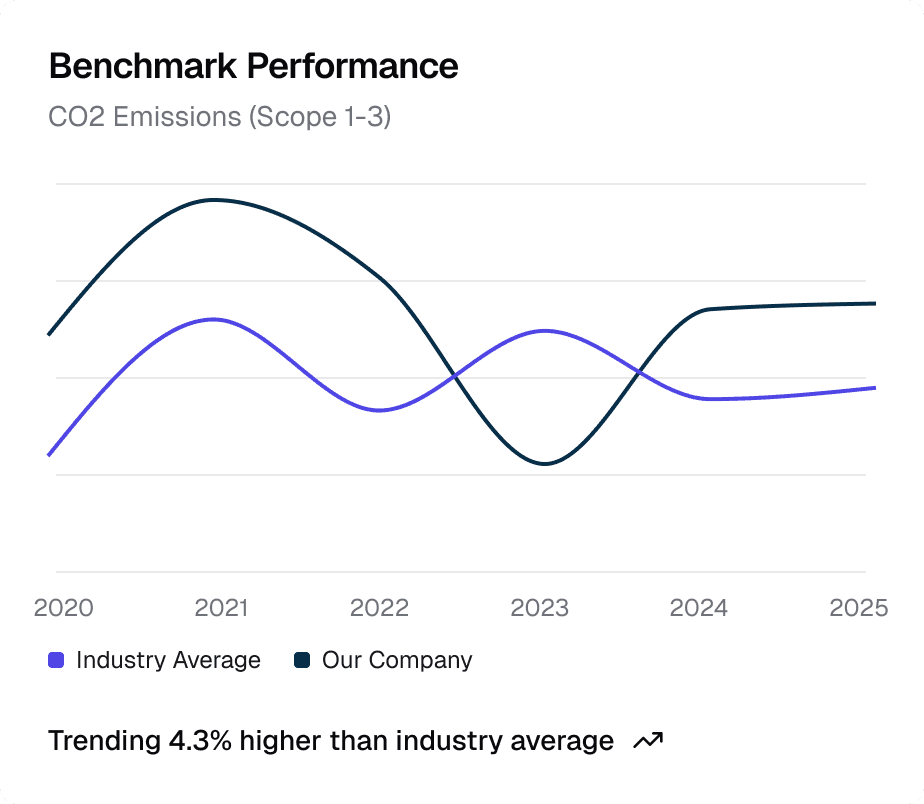
Scope 3 emissions are gaining prominence as regulators, investors, and customers demand visibility across the entire value chain. Measuring supplier and product-related emissions is complex, but increasingly unavoidable.
Carbon tracking at multiple levels, corporate, product, and supply chain, is becoming standard practice. Companies are expected not only to measure emissions, but also to show credible reduction pathways.
Finally, ESG data is becoming more decision-oriented. Rather than existing only for disclosure, it is increasingly used to guide procurement, product design, investment decisions, and risk management.
How Companies Can Prepare for Future Expectations
ESG reporting is evolving quickly, and for companies new to the topic, the changes can feel overwhelming. But a few major trends explain where things are heading and why expectations are rising.
1. From Annual Reports to Continuous Data Tracking
In the past, many companies treated ESG like a yearly project. Data was collected once a year, compiled into a report, and published.
That approach is becoming outdated.
Today, investors, regulators, customers, and even employees expect more regular visibility into performance. They want to know:
Are emissions decreasing this quarter?
Is energy consumption improving year over year?
Are supplier risks being monitored continuously?
This means ESG data needs to be tracked more frequently, sometimes monthly or quarterly, rather than gathered in a rush before a deadline.
For companies, this shift requires better internal systems. Instead of asking, “What happened last year?”, the question becomes, “How are we performing right now?”
2. Scope 3 Emissions Take Center Stage
For many organizations, Scope 3 emissions represent the largest part of their carbon footprint. These emissions come from the value chain (suppliers, transportation, product use, business travel, and more).
For example:
A clothing brand’s biggest emissions may come from textile production and manufacturing.
A technology company’s largest impact may come from how customers use its products.
A retailer’s emissions may be heavily concentrated in its supply chain logistics.
The challenge is that companies do not directly control these emissions. They rely on suppliers and partners for data, and sometimes must use estimates. Despite this complexity, regulators and investors increasingly expect transparency in Scope 3 reporting. Ignoring it is no longer an option.
For beginners, this is one of the biggest mindset shifts: measuring only what happens inside your own offices or factories is not enough.
3. Carbon Accounting at Multiple Levels
In the past, companies mainly focused on calculating their total corporate carbon footprint. Now, expectations are expanding. Companies are now expected to measure emissions at several levels, not just across the organization as a whole. This includes calculating their overall corporate footprint, but also assessing the carbon impact of individual products and analyzing emissions across their supply chain, from suppliers to logistics. This multi-level approach provides a much clearer picture of where emissions truly occur and where reduction efforts can have the greatest impact.
For example:
A food company might discover that packaging contributes more emissions than ingredients.
A manufacturer might find that a single raw material drives most of a product’s carbon footprint.
A company might realize that one supplier represents a disproportionate share of Scope 3 emissions.
This level of insight allows companies to target reductions more effectively instead of applying broad, unfocused measures.
4. ESG Data Is Becoming a Business Tool
In the past, many companies collected ESG data mainly to publish it, for annual reports, sustainability disclosures, or external questionnaires. Once the report was submitted, the data often sat untouched until the next cycle.
That mindset is shifting. More organizations are starting to use ESG data as a practical management tool. Procurement teams compare suppliers based on carbon performance and risk exposure. Product teams look at emissions data to choose lower-impact materials. Finance teams factor climate risks into long-term investment decisions. Operations teams identify inefficiencies through energy and resource tracking.
For example:
Procurement teams may favor suppliers with better carbon performance.
Product teams may switch to lower-impact materials.
Finance teams may integrate climate risks into long-term planning.
When ESG data is used this way, it stops being a reporting obligation and becomes part of everyday decision-making. It moves from the communications department into the core of the business.
A More Realistic View of ESG Leadership
It’s tempting to think that leadership in ESG comes from publishing more data or longer reports. But volume is not the same as value. The companies that will stand out are not those that disclose the most information. They are the ones that understand their data, trust its quality, and use it to guide real decisions, reducing risk, improving efficiency, and identifying opportunities.
The real shift happening in ESG reporting is not just regulatory. It’s operational.
Organizations are moving from “reporting after the fact” to actively managing sustainability performance as part of day-to-day strategy. And that is where ESG starts to become truly useful not just compliant.



Learn More



FAQs
Data security
We take data security very seriously. ECO-OS uses enterprise-grade security measures, including encryption, secure data storage, regular security audits, and compliance with leading industry standards. Your sensitive ESG data remains private, secure, and confidential at all times.
Do you provide implementation support?
Absolutely! Our professional services team is among the most talented and experienced in the business. They provide hands-on implementation support, systematically guiding your team every step of the way. From initial data discovery and onboarding of users to training and integration, our experts ensure your team rapidly closes gaps and creates new value with ECO-OS.
Do you also support Scope 3 reporting?
Of course. ECO-OS provides an end to end solution for Scope 3 emissions following the guidance of the GHG Protocol. A suite of tools unique to our platform simplifies the complex task of communicating, collecting and aggregating your supply chain data, helping you clearly understand your full value chain emissions and devise actionable reduction programs.
What international standards and frameworks are supported by ECO-OS?
ECO-OS supports alignment with major global ESG reporting frameworks, including CSRD, the GHG Protocol, California SB 253 and SB 261, the UN Global Compact, the UN SDGs, and other leading international standards.
Start Your Journey to Compliance and Growth Today